Showing posts with label Bahamas. Show all posts

Thursday, June 2, 2016

When Worlds Collide :: Queen Victoria

In the center of Nassau you'll find the old and the new worlds coming together. Rawson Square features a new beginning with a bronze of Sir Milo Butler who was the first governor-general for an independent Bahamas. And on the other side of the street is Parliament Square with Queen Victoria representing a colonial past.

The commercial port of Nassau was established around 1670. It was overrun for more than a century by lawless, seafaring men, and it was twice destroyed by both Spanish the French. The port also saw its share of pirates who would loot the heavily laden cargo ships. So by the early 1790s, the British decided they'd had enough and built several fortresses to restore order and protect the island from invaders. Fincastle was built on top of Bennet Hill and has two 24-pound cannons, two 32-pound, two 12-pound and a Howitzer. The fort never fired once even with all this firepower. 

Toward the end of colonial rule (late 1700s) local African slaves carved a gorge, more than 100 feet deep into a solid limestone hillside with pickaxes. At the far end of this passage they included a staircase of 66 steps to provide a shorter route to Fort Fincastlethe highest point on the island. The task took 600 slaves 16 years to complete. The Queen's Staircase were named decades later (1837) when Queen Victoria signed a declaration to abolish slavery on her ascension to the throne. Later, the staircase was modified to 64 steps, each representing a year of Queen Victoria's reign. 

It is a short 10 minute walk up from the port to the staircase where a wall of vines and overhanging brush offer a cool oasis on a hot day. Climb the stairs and you arrive at Fort Fincastle where you will get a stunning 360 view around the island and a birds' eye perspective of the enormous cruise ships coming and going in the port. You'll see the hoards of tourists scuttling off the ships to the straw market or one of the touristy bars, but very few venture beyond the couple of streets that surround the port. A shame because there is so much more to see on the island.
Monday, May 30, 2016

Memorial Day :: Clifton Heritage Park

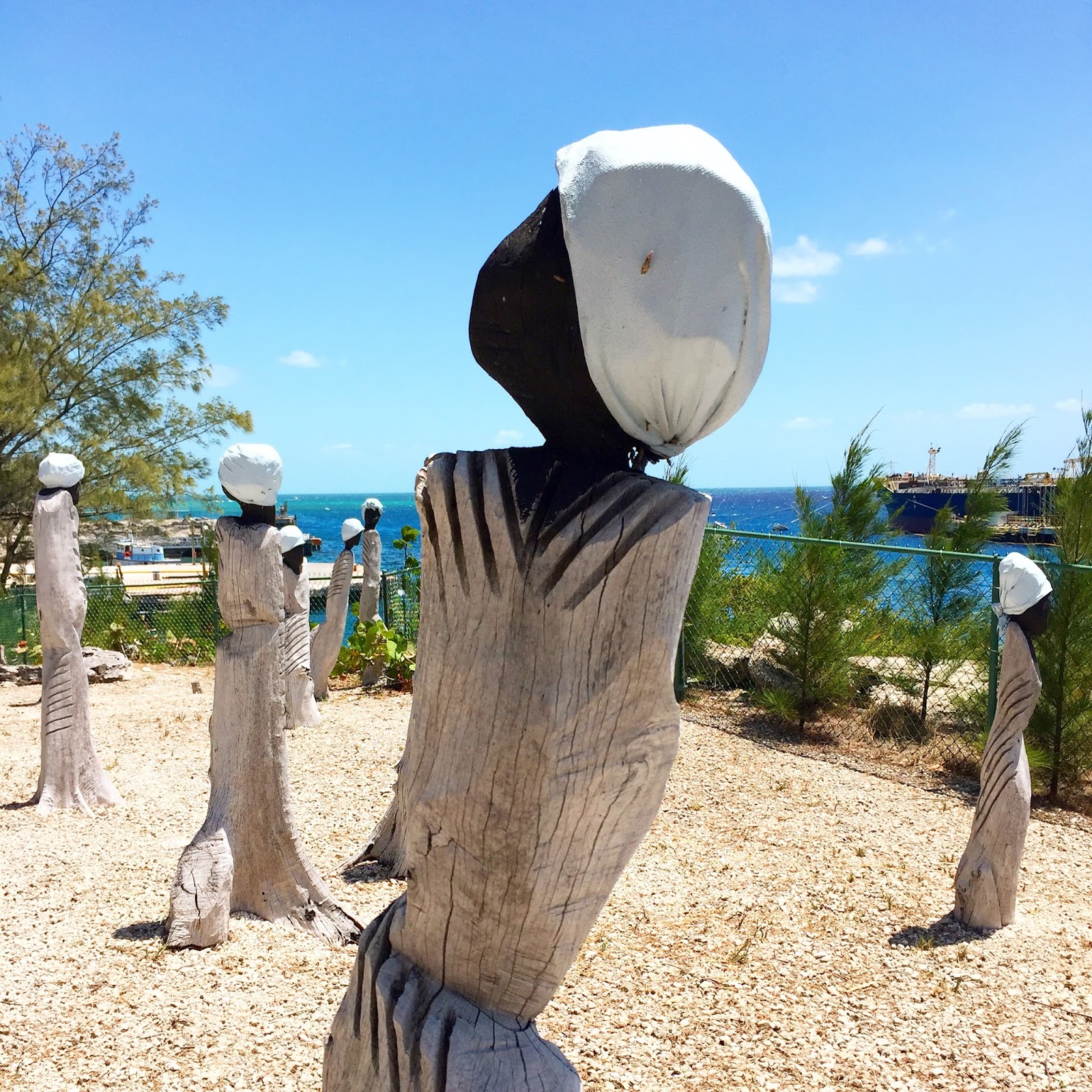
Sacred Space Sculpture Garden
One of the most interesting places we visited while in the Bahamas was Clifton Heritage Park on the Western tip of the island of New Providence where slaves were brought ashore. A place where European ships dock after a grueling Middle Passage sail across the Atlantic with human cargo in their hulls. It is the Bahamas first national park that protects and preserves a deep history of slavery. Not to celebrate it, but to learn and remember those that lived their entire lives on this plantation. While exact counts vary, it is estimated that 11 to 15 million Africans were kidnapped from their homes and forced into slavery during the 16th - 19th centuries.


Slave home ruins
There is a sculpture garden by Antonius Roberts that he calls Sacred Space with African figures carved from driftwood. It is a tribute to the first wave of those who came ashore here. The figures face to the East, in the direction of Africa. The area is remote, but not far outside of Nassau. No public transportation extends this far, but it is easy to hire a car for a short 15 minute drive out to the park. 

The plantation at one point was owned by William Wylly, the Attorney General of the Bahamas. He is said to be one of the more benevolent slave owners, if that is a term you'd use to talk about slavery? He would encourage his slaves to marry and when they did he'd build them their own home. You can see the remains of these homes in the slave village ruins. He also employed a plantation overseer that was of African origin, who also happened to be the local pastor of the church that served the African community.


Coral reef underwater sculpture garden overlook
The beauty of the beaches around the point has made it a popular place to visit. But it also attracted developers who wanted to exclude the public and build a gated community. Bahamians protested to preserve the area as a park with historical significance and what they call a 'cultural treasure' to the local people.

We spent the day hiking around the plantation and snorkeling in the cove where there are sunken statues. Since I have no idea how to do underwater photography I'll give you a link so you can see what is under the surface. The fish were amazing and everywhere. It is a stunning location with panoramic views of the ocean along the cliffs.


Cotton growing wild
The Bahamas is associated with 'Loyalists' who fled the US following the Revolutionary War. They moved to the Bahamas to continue the production of cotton which was in decline due to boll weevil infestations, and a series of devastating hurricanes. Within 20 years, the economy collapsed and many of the landowners abandoned their plantations and returned to England. The slaves were left to fend for themselves.

The British emancipated slavery in 1834 throughout the Empire. At this point the Bahamians were "free to establish their lives according to their own beliefs and in pursuit of their individual happiness." The British establish an apprenticeship program through August of 1838 where they were required by law to teach their former slaves the needed skills to work and provide for themselves. One thing I found fascinating is that the US abolishment of slavery came some 31 years later. What took so long? Too bad the American's didn't take a page out of Bahamian history and not only abolish it earlier, but help to usher them in to a life of freedom.

Saturday, April 30, 2016

Bahamian Flowers

Hibiscus
Elder Flower
The Bahamas was in full bloom when we were there last week. Lots of flowering bushes, trees and vines like the colorful leaves of Bougainvillea. 

I think what surprised me most was that I was expecting the Bahamas to be more year-round tropical temperatures. But apparently temps do vary quite a bit and even dip into the 40s (or so our cab driver told us), but we had beautiful 70 degree weather all week.

We had arrived just as so many trees were blooming, one of which is the national flower called the Elder Flower. It looks like clusters of yellow trumpets. The flower has a number of medicinal uses ranging from digestion to high blood pressure or even catnip. I was surprised to learn that honey produced from these flowers can actually be poisonous to humans, and there must be quite a lot of it since the bees were very attracted to it. Perhaps think twice about buying Bahamian Honey!

Saturday, April 16, 2016

Caribbean Blue :: Larimar

This year the hubby was determined to plan several escapes from the winter given how brutal winter was last year. And while it was much more mild this year, it has been nice to get some sun early in the season. 

The second trip he planned was the Bahamas, and while I've been here before a few times, they were quick single day excursions from a ship. It is much different to stay locally just off the beach. Our place has its own pool and a quick walk up to shops, restaurants and local beaches. It is the perfect place to simply relax. 

One thing that always strikes me about the Caribbean is the color of the water. It is just so blue. And when I recently saw this stone I just could not resist as it looks like the color of the water and seems to have the pattern of surf in it. The stone is called Larimar. 

A bit of quick research revealed that it is a stone found only in the Caribbean, specifically the Dominican Republic. It was named after the daughter of the man who rediscovered it in 1974, Miguel Mendez. He combined his daughter's name (Larissa) with the Spanish word for sea (mar) to create the name. The Dominican Republic's Ministry of Mining show records that in 1916 Father Miguel Domingo Fuetes Loren asked for permission to mine for a certain blue rock he had discovered, but he was denied. Years later Miguel Mendez, a Peace Corps volunteer, rediscovered the stone walking along a local beach.

The stone is formed from a crystallization of blue pectolite when it is pushed into the 'tubes' or 'chimneys' of a volcano by the hot gases. Today there are networks of mines left behind from crews who have had to excavate deeper and deeper into the old volcanoes.

It really is a striking stone, and I didn't want to over complicate the setting. So I decided to stay with the blue theme and used a thick blue leather cord and set the focal with silver. I kept it short as a simple choker with a magnetic closure in back. 

AntiquityTravelers on Etsy